
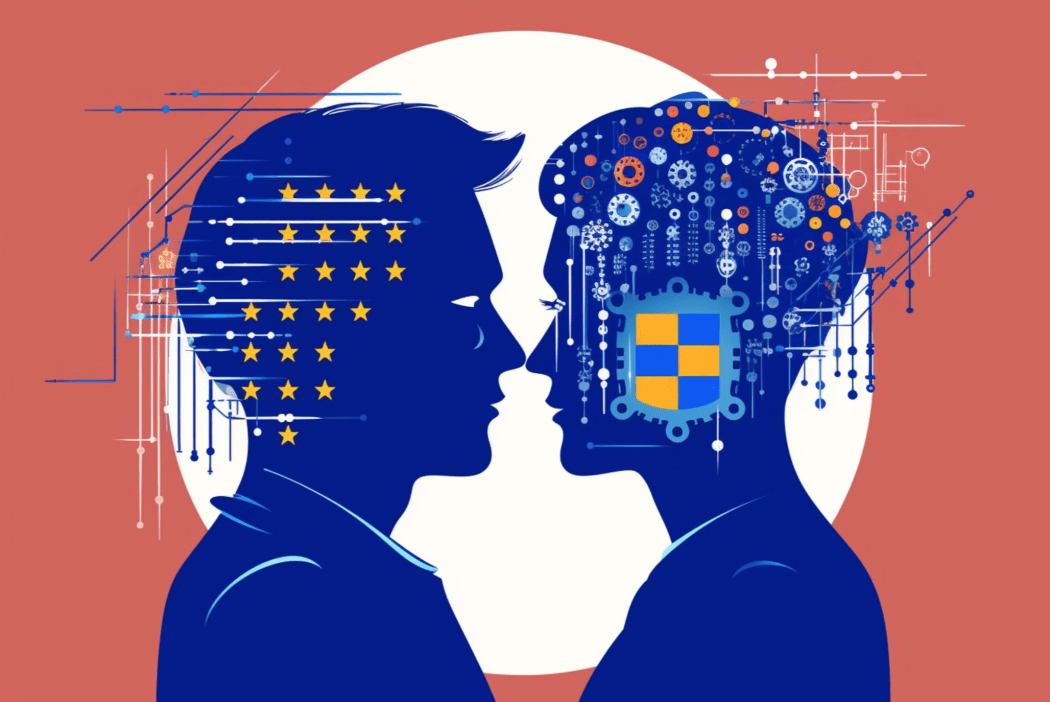
Most Americans do not meet artificial intelligence as a policy issue. They meet it when a chatbot writes a school email, a hiring tool ranks a resume, a bank screens a loan, or a hospital system flags a patient record. That is why AI Regulation now feels less like a legal niche and more like a daily-life question. The fight is not only about stopping bad systems. It is about deciding who must prove safety, who carries blame, and how much freedom companies get before harm shows up. For readers following technology policy trends, the real story is the split between Europe’s rulebook model and the U.S. habit of governing through agencies, procurement, state laws, and presidential orders. The EU AI Act puts risk categories on paper. American executive orders move faster, but they can swing when administrations change. That tension matters for U.S. founders, workers, parents, investors, and local officials who now need rules that protect people without freezing useful tools in place.
Europe Turned Risk Into the Main Legal Language
Europe made one early bet: not every artificial intelligence system deserves the same treatment. A spam filter, a medical triage tool, a school admissions system, and a police biometric database should not sit in one legal bucket. The EU AI Act entered into force on August 1, 2024, with its full application planned around a staged timeline. Prohibited practices and AI literacy duties began applying on February 2, 2025; general-purpose model obligations became applicable on August 2, 2025; and later high-risk dates now include December 2, 2027 for several high-risk areas and August 2, 2028 for product-integrated systems after simplification talks. The European Commission’s AI Act implementation page is the safest public starting point for that timeline.
Why the EU AI Act starts with use cases, not slogans
The European model is strictest where a system can touch rights, safety, or life chances. That includes areas like employment, education, border control, biometrics, critical infrastructure, and certain product safety contexts. The law’s plain insight is that harm comes from placement as much as from code.
Think about a résumé-screening tool used by a large retailer in Chicago. The model may look like ordinary software to the vendor. To an applicant, it can decide whether rent gets paid next month. Europe’s approach pushes the vendor and the deployer to ask harder questions before the system shapes a person’s future.
There is a less obvious benefit here. Risk categories force business teams to map where artificial intelligence sits inside the workflow. Many companies discover that the tool they feared most, such as a public chatbot, is not their highest exposure. The quiet ranking model inside hiring, lending, fraud review, or insurance may carry the heavier legal weight.
What Brussels understands that Silicon Valley often resists
The European approach treats documentation as a safety tool, not paperwork for its own sake. That annoys builders who want to ship fast. Some of that frustration is fair. A small U.S. startup selling into Europe may feel buried under definitions before it earns its first dollar.
Yet documentation has a purpose when a system fails. If a hospital uses an artificial intelligence tool to flag patient risk, someone must know what data shaped it, who tested it, what limits were known, and where human review enters. Without that trail, accountability turns into a fog. No patient wants to hear that the vendor and the hospital are still figuring out who owned the decision. The same problem appears in schools when a district buys a student-risk tool and later cannot explain why one teenager was flagged while another was ignored.
The counterintuitive part is that strict rules can help serious companies. Clearer duties may scare off careless vendors who sell magic with no audit path. For U.S. firms with strong engineering records, model cards, testing logs, and customer controls become sales assets. The rulebook becomes a filter, not only a burden. In a sales call, that can change the mood. Instead of promising that a model is fair, a vendor can show who tested it, what failed, what changed, and what still needs human judgment.
AI Regulation in the United States Moves Through Power, Not One Statute
The United States has not built one national statute like Europe’s. Instead, it uses a patchwork: federal agencies, White House orders, NIST guidance, procurement standards, court fights, and state laws. That system can look messy because it is messy. It also fits American politics, where Congress often moves slower than the technology it wants to govern. A U.S. business may face one set of expectations from a federal agency, another from a state attorney general, and another from a corporate buyer. A school district in Texas, a health insurer in New York, and a defense contractor in Virginia may all use artificial intelligence, but they do not face the same pressure points.
Why American executive orders can move fast and vanish fast
The strongest recent lesson is instability. President Biden’s 2023 order on safe, secure, and trustworthy artificial intelligence pushed federal agencies toward safety testing, civil-rights review, and risk management. In January 2025, President Trump’s Executive Order 14179 shifted the posture toward U.S. dominance, innovation, national security, and the removal of policies seen as barriers to development. The order also directed officials to review actions taken under the revoked Biden order and suspend, revise, or rescind those that conflicted with the new policy.
That matters for Americans trying to plan. A company building a model for federal use cannot treat a presidential order like a settled statute. It may guide contracts, agency behavior, and enforcement tone, but it can change after an election. That is a feature of executive power and a weakness at the same time.
The non-obvious lesson is that unstable rules reward mature internal governance. If a company depends only on the current White House mood, its controls will lurch every four years. If it builds an internal review system that can satisfy buyers, regulators, and courts, it becomes less exposed to political weather. The boring file folder becomes a shield. That shield matters when a buyer asks for proof, when a regulator sends a letter, or when a user challenges a decision. The company that kept records has a story it can defend.
How NIST and state laws fill the gap
NIST sits in a different lane from the White House. Its AI Risk Management Framework is voluntary, but it gives companies a way to discuss risk across design, deployment, use, and evaluation. NIST says the framework is meant to improve how organizations build trustworthiness into artificial intelligence products, services, and systems; it also notes that AI RMF 1.0 is being revised.
State laws add another layer, and Colorado shows how quickly that layer can shift. The Colorado Attorney General’s office says Senate Bill 26-189 was signed into law in May 2026, repealing and reenacting earlier provisions with new requirements for automated decision-making technology in consequential decisions. The office says the new law gives consumers rights tied to inaccurate personal data and goes into effect on January 1, 2027.
For a U.S. employer, that can become real fast. Say a Denver company buys an automated hiring tool from a national vendor. The vendor may need to explain the system. The employer may need a notice process and a human route for disputes. The tool is not banned. It is put under adult supervision. That is where U.S. policy often lands: less like a locked gate and more like a set of duties around notice, review, correction, and proof.
The Global Split Comes Down to Trust, Speed, and Market Control
Global policy debates often sound like Europe cares about safety while America cares about invention. That is too clean. Europe wants domestic artificial intelligence champions too. America wants trustworthy systems too. The sharper divide is about where each system places the first burden. Europe tends to ask companies to prove they have managed risk before or during market entry. The United States often lets markets move first, then uses agencies, lawsuits, buyer rules, and state statutes to correct problems. Neither approach is pure. Both create costs. Both miss some harms. Europe may slow a useful product while teams argue over categories. America may let a risky product spread before anyone has enough records to fix the damage.
Why companies cannot treat policy as a legal-only chore
For U.S. companies selling across borders, global rules now shape product design. A vendor that sells a hiring model in Boston and Berlin may need one documentation system, one testing culture, and one customer-control layer that can satisfy several regimes. Splitting the product by country may sound cheap until engineers must maintain two versions of every safety process.
This is where AI governance frameworks become practical. A framework cannot solve policy conflict, but it can give a company a shared map: what the model does, who it affects, how it is tested, where a human can override it, how complaints are handled, and what happens when performance drifts. AI governance frameworks also help non-lawyers speak the same language as counsel, auditors, sales teams, and product managers.
One counterintuitive move is to design for the strictest credible customer, not the weakest legal rule. A vendor that can pass a European bank’s review may find it easier to sell to a U.S. hospital, insurer, or school system. Trust travels through procurement long before it appears in a courtroom. A county health office or regional bank may never cite a European article number, but it will ask the same practical questions: Who tested this, who can override it, and what happens when it fails?
The export race is also a standards race
The current U.S. federal posture links artificial intelligence to national power. The official AI.gov page describes America’s AI Action Plan around three pillars: accelerating innovation, building AI infrastructure, and leading international diplomacy and security. It also lists executive orders on exports, data-center infrastructure, federal procurement, education, and American leadership.
That tells you the fight is not only about domestic safety. It is about whose tools, cloud systems, chips, model weights, security habits, and contract terms become normal for the rest of the world. If U.S. products dominate, U.S. habits spread. If European rules become the price of market access, European habits spread too.
A simple example is an American software firm selling a customer-service model to airlines in the U.S., Germany, and Brazil. The firm may not love European paperwork, but it may still adopt those controls everywhere because one global process is cheaper than three weaker ones. Policy can travel through the supply chain even when a law stops at a border. The sales team may feel the rule first, not the legal team. That is why global policy becomes a product feature. The companies that hide controls behind legal memos will lose to companies that make safety settings, audit exports, and explanation tools easy for buyers to inspect.
What Americans Should Watch Before the Next Wave Hits
The next phase will not be settled by one law or one speech. It will be shaped by procurement clauses, state enforcement, agency guidance, lawsuits, trade pressure, and public trust after real failures. For everyday Americans, the strongest question is not whether artificial intelligence should be allowed. It is where people deserve notice, appeal, testing, and a human route out of a bad machine decision. That question changes the tone. It moves the debate away from fear and toward rights you can use. It also makes local choices matter, because states, cities, schools, hospitals, and employers often touch people before Washington does. A parent may not read a federal memo, but they will notice when a school chatbot gives unsafe advice or when a child’s record is scored by a tool no one can explain.
The hidden fight over who pays for mistakes
When an artificial intelligence system harms someone, blame can scatter. The model developer points to the customer. The customer points to the vendor. The data provider points to the contract. The human reviewer says the screen looked confident. In that confusion, the person hurt by the decision gets stuck.
Good governance tries to stop that scatter before it starts. Contracts can assign duties. Logs can show what happened. Testing can reveal weak spots. Notices can tell people when a system is involved. Appeal paths can give a rejected tenant, patient, applicant, or borrower a real chance to challenge an outcome.
The non-obvious point is that accountability is not only punishment after harm. It is design before harm. A lender that knows how to explain an adverse decision may make better choices before the letter goes out. A school district that demands bias testing may buy fewer shiny tools that cannot survive scrutiny.
How readers can separate serious policy from theater
Political fights over artificial intelligence will keep getting louder. Some leaders will warn about bias, deepfakes, and job loss. Others will warn that rules hand the future to China or bury startups. Both worries can be valid. Neither side earns trust by pretending the other problem is fake.
The Trump administration’s December 2025 order on a national policy framework made the federal-state conflict plain. It argued for a lighter national framework, directed the Justice Department to challenge state artificial intelligence laws seen as inconsistent with federal policy, and told Commerce officials to evaluate state laws that may conflict with the order.
Serious policy has a few signs. It names the use case. It says who must act. It creates records. It gives affected people some form of notice or remedy. It can be audited. It does not rely on a press conference as the main control.
For readers tracking responsible technology adoption or planning AI risk management for business, that checklist matters more than party language. A useful rule makes the system safer to buy, safer to use, and easier to challenge when it goes wrong. A weak rule mostly gives officials something to announce. That difference will matter more as artificial intelligence moves from chat windows into payroll systems, medical billing, utility planning, and local police tools. The closer the system gets to daily life, the less patience Americans will have for vague promises.
Conclusion
The world is not choosing between control and invention. It is choosing where proof, trust, and risk should sit. Europe puts more of that weight at the front door through the EU AI Act, while the United States spreads it across agencies, procurement, state experiments, courts, and American executive orders. That makes the American path faster in some moments and shakier in others. AI Regulation will keep changing because the tools keep moving, but the human questions are already clear: who is affected, who checks the system, who explains the decision, and who fixes harm when the machine gets it wrong. The smartest U.S. companies will not wait for one perfect national law. They will build records, testing habits, appeal routes, and buyer-ready controls now. That is not red tape. That is how artificial intelligence earns a place in serious American life.
Frequently Asked Questions
How does the EU AI Act affect American companies?
American companies can be affected when they place artificial intelligence systems on the EU market or serve EU users in covered contexts. The main impact is practical: stronger documentation, risk classification, transparency duties, and controls for high-risk uses.
Are American executive orders the same as federal law?
No. They direct federal agencies and shape government policy, procurement, and enforcement priorities. They do not replace Congress. A later president can revise or revoke many parts, which makes them faster than statutes but less stable over time.
What is the biggest difference between European and U.S. AI policy?
Europe uses a risk-based legal structure with clearer categories. The United States relies more on agencies, voluntary frameworks, state laws, procurement rules, and presidential direction. For companies, the U.S. model can feel flexible but harder to predict.
Why does AI policy matter to ordinary workers?
Hiring, scheduling, productivity scoring, fraud review, and benefits decisions may involve artificial intelligence tools. Workers need notice, review options, and protection from unfair outcomes, especially when a system influences pay, promotion, discipline, or access to work.
Is the NIST AI Risk Management Framework mandatory?
No. It is voluntary, but many organizations treat it as a serious guide for internal controls. It can help teams organize risk reviews, testing, documentation, and trustworthiness goals before a product reaches customers or public users.
Can state AI laws conflict with federal policy?
Yes, conflict is possible. States may target discrimination, consumer notice, or high-risk decision systems, while federal leaders may prefer national consistency. Courts, agencies, and Congress may decide how far state rules can go.
What should small businesses do before using AI tools?
Start with the use case. A writing assistant for marketing copy carries different risk than a tool that screens tenants, applicants, patients, or borrowers. Keep records, review outputs, notify people when needed, and avoid systems vendors cannot explain.
Will global AI rules slow innovation?
Some rules will slow careless launches, but that is not the same as blocking useful products. Clear testing, documentation, and accountability can help serious companies win trust, especially in healthcare, finance, education, insurance, and government contracting.